Categories
3. Content publishing for tablets 7. Vocabulary

Multilingual content with language switch

The publication software Triobo also supports multilingual content in digital publications for tablets . In one reader the publisher can publish (usually identical) content in multiple language versions. The reader then can see the content primarily in his own language, with option to switch to other languages any time. The default language of a particular reader is selected automatically according to the language settings of his tablet.

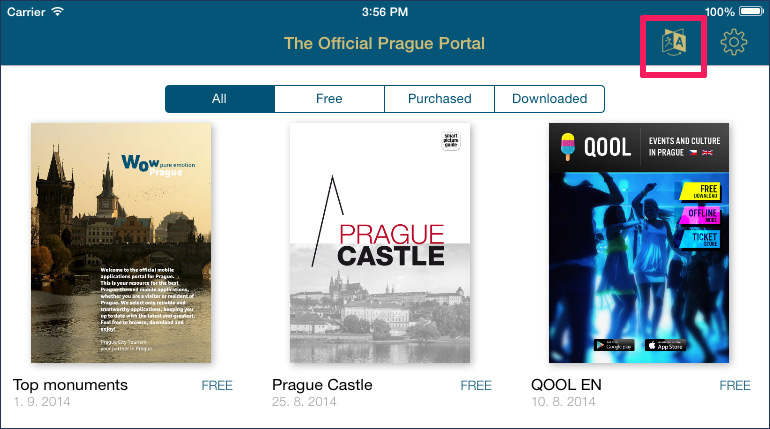
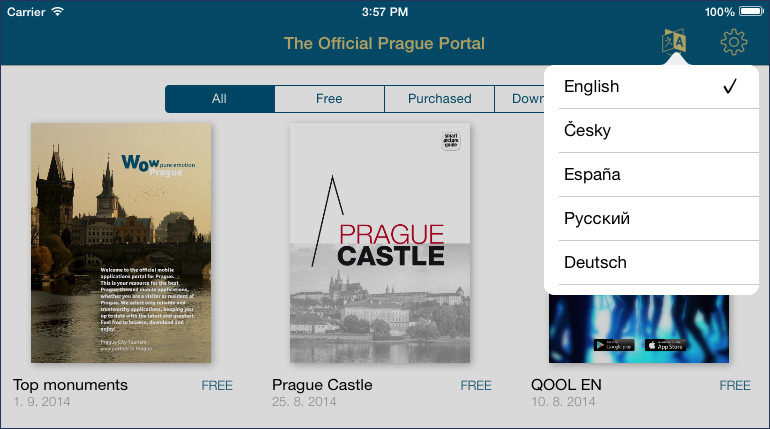
Language switch icon Rolled out language switch

Usually this option is used with publishing portals, typically in tourist guides or interactive catalogs. Multilingual content with switches may be published by every publisher with switching option in Triobo Professional tariff or higher.

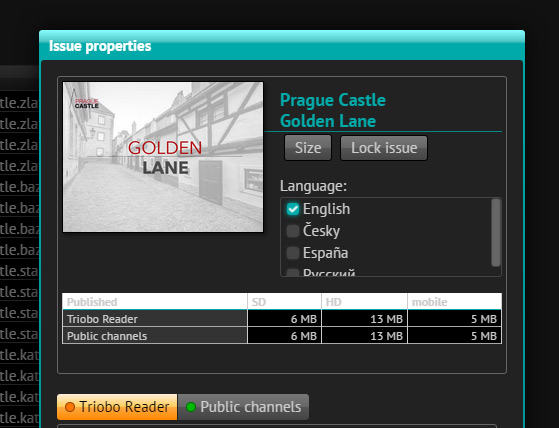
From the publisher perspective, the individual language versions are assigned to appropriate language in Triobo editor, under the Settings dialog of issue properties (if language version with switching is activated in your reader): ! Multilanguage setting and publications

Note.: any publisher with Triobo Start tariff may also publish multilingual content, his readers however do not have the language switch available in their reader and will see all language versions of publications next to each other. The professional way of publishing multilingual publications with switch option is introduced until the Triobo Professional tariff.

Categories
3. Content publishing for tablets 6. Marketing & digital publications 7. Vocabulary

Publishing portal

In publishing software Triobo you can not only create digital magazines and single publications, but also compact packages of independent publications with related content – all within a single application. Such an application is called publishing portal.

Triobo Kiosk is more suitable if you want to have a package of digital magazines in one application. More information about the differences between publishing portal and Triobo Kiosk.

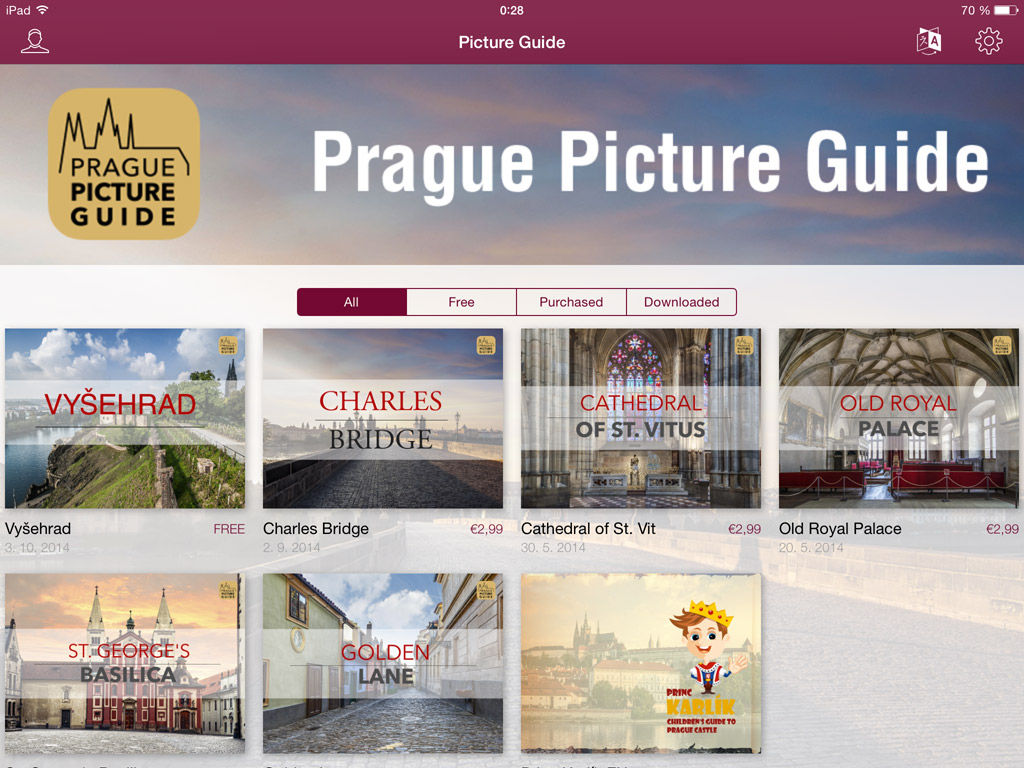
A typical example may be a set of independent tour guides offered in the App Store / Google Play under one icon, for example The Official Prague Portal (individual publication on Prague is free of charge) or The Prague Picture Guide (set of charged tourist guides). Other examples may be sets of company information materials (catalogs and documents for customers) or even digital portfolios of creative agency.

enter image description here The shared framework of a single application is very important from marketing point of view – even if you have separate series of tourist guidebooks, you do not advertise them all individually; just inform interested visitors of the existence of a single application, where they “find it all”. Instead of twenty separate references to twenty different applications you will use just one link.

Publishing portal may include:

  • Any combination of charged and free publications
  • Reader’s Zone – You can distribute coupons that substitute the payment in App Store / Google Play – at cash registers of tourist attractions (Triobo Professional tariff) for example
  • Language versions – the entire publishing portal may have multilingual content, among which readers can switch. Typically, a tourist guide in English, German, Spanish … and yet everything under one application.
  • Publishing portal can be also connected to the external payment gateway – and perhaps allowing you to sell charged tablet publications through your e-shop outside of App Store / Google Play (Triobo Professional tariff)
  • PDF (static) documents
  • Etc.

An important feature of publishing portal is the choice to instantly update on-line content or add additional publications.

Publishing portal is accessible in tariffs Triobo Start and Professional.

There are no special settings required, in fact this is the same model as in case of tablet magazines. The difference is only in slightly shifted meaning of terms: publishing portal is understood in Triobo Editor as a “publication” while individual publications in a publishing portal (eg. individual tourist guides) are then processed in the editor as “issues”.

Categories
3. Content publishing for tablets 7. Vocabulary

Partially charged publication

Imagine that you want to create paid interactive publication for tablets, for example a tourist guide, and you want to give the visitors a chance to see few pages for a trial. Yes it is possible, with publishing software Triobo you may create partially charged publications.

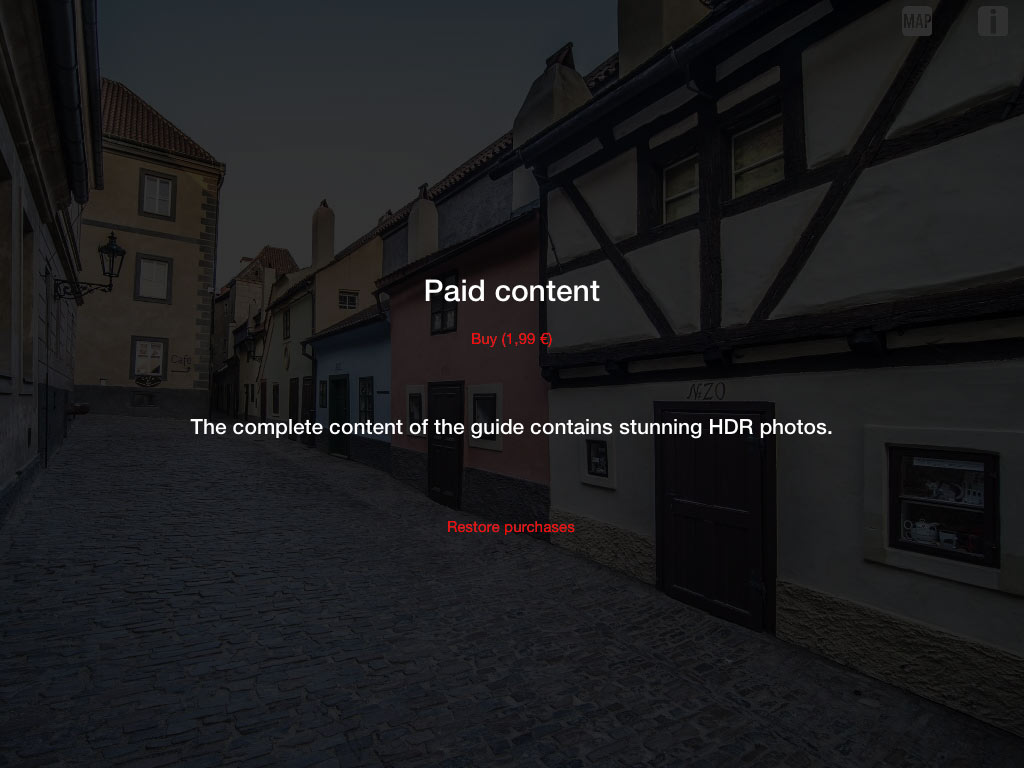
You may mark specific pages within the digital publication that will be available to readers free of charge while the access to other pages will be subjected to payment of subscription amount over the App Store / Google Play. Typically, the publisher sets the first X pages for free; then when readers turn to other pages the subscription content of publication will be offered to them to buy. They do not buy individual pages of publication, but paid content as a whole.

Triobo - paid content showcase Partially charged publications can be created within the price tariff Triobo Single – for one-time publications.

For more information do not hesitate to contact us.

Categories
3. Content publishing for tablets 5. Succesfull digital publication 6. Marketing & digital publications

Reader’s Zone (vouchers and coupons)

In the context of pricing options, Triobo Professional offers advanced functions to support the marketing of paid digital magazines – Reader’s Zone with vouchers (coupons).

Why Reader’s Zone?

Thanks to the Readers Zone, publishers have the opportunity to use coupons as a marketing tool of digital publications as an alternative payment channel. Coupons represent the unique group of letters and numbers that you may send to your readers or business partners with an e-mail, or printed to any type of media connected to your publication.

Coupon – a tool for digital magazine promotion

Typical use of coupons:

  • time-limited digital magazine subscription that is free to current subscribers of your printed version
  • gift to your business partners (e.g. free annual subscription to the magazine)
  • gift to clients of your advertisers (“when you buy a tablet in your online shop, you will get an annual subscription worth $ 30 from MyMagazine for free”)
  • option to sell digital magazine subscriptions alternatively to the Appstore / Google Play – saving charges

Coupon may also be:

  • unique – can be used only once – suitable for sending target marketing e-mails
  • general – (e.g. suitable for placement in printed advertising – an unlimited number of readers may use it, but only within predefined time period)

Voucher value

Each coupon can be an equivalent to the payment of a particular issue of your digital magazine, or a specific type of subscription.

Example: you may have a coupon for a “single item purchase”, which allows free downloading of the paid edition of MyMagazine, Edition 1/2014. Or you can create a coupon that corresponds to a quarterly subscription you are offering in Appstore.

How coupons work

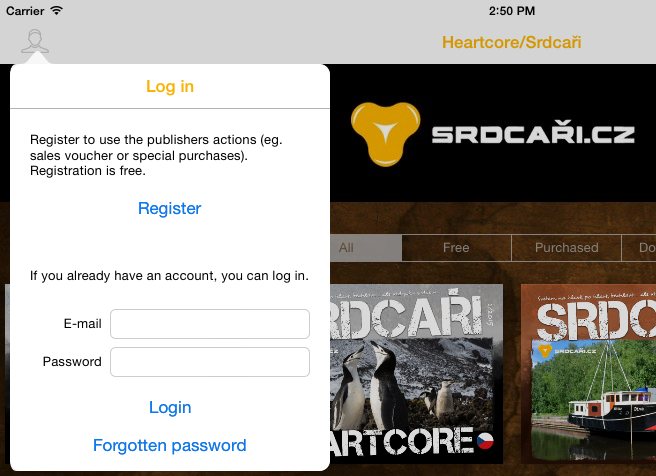
Prepare simple instructions for your readers describing how to use coupons (see example). Your reader must simply start the digital magazine reader on his device and select the Reader’s zone, then fills his/her email and password (if they do not have it, they must register). Here is the point where the appropriate coupon is inserted. Depending on the type of coupon the reader selects a relevant issue of digital magazine as “paid” and then they are free to download it.

Readers who want to use the coupon must register first (using e-mail and password) – so in the future they can renew their subscriptions. Registration will take place inside of Triobo publishing account; only the publisher has access to this information. The advantage is that you know specific emails of your particular readers and are able to work with them.

Categories
3. Content publishing for tablets 5. Succesfull digital publication 6. Marketing & digital publications

Reader’s Zone – user guide for your readers

Reader’s zone is an advanced function of Triobo digital publishing tool that is primarily used for marketing support of paid digital magazines.

Thanks to Reader‘s Zone you may offer coupons to your readers which will replace payments that are made through the Appstore/Google so the reader can recieve free magazines. This is ideal in situations where you want to give a gift to your already subscribed readers of printed magazines by offering them a free digital magazine for limited time.

It is recommended that you inform your readers about how they can use your gift. Instructions for using coupons and Reader’s Zone might look like this:

How to redeem a digital magazine coupon

To get a specific issue of a free digital magazine (or subscription), you need to be registered to Reader‘s Zone. Registration is required for your future identification which allows you to restore your purchases when needed.

Operating procedures for Apple iOS:

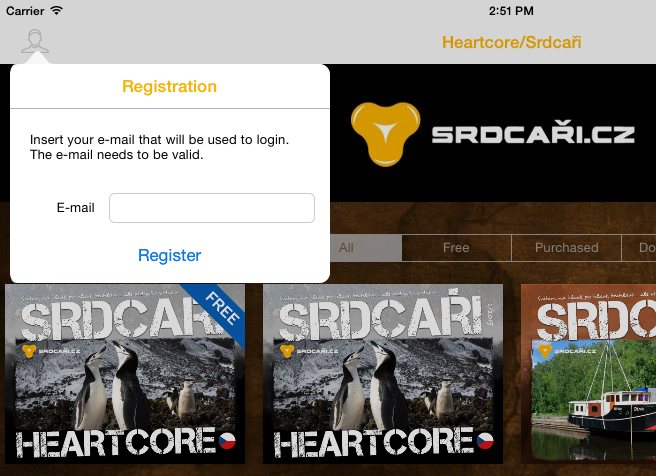
  1. In your magazine reader, in issue overview, select the “Reader’s Zone” at the top left (for Android: “Login” at the top right), press the last button “Register”and fill in your e-mail. The e-mail must be valid, because we will use it for sending you an activation message. If the publisher allows you to log in without e-mail verification, you may immediately log in and insert your coupon. In any case, activate your e-mail and pick the password so you can log in again in the future.
  2. An activation message will be delivered to your mail box with a link – click on it (or copy it to your web browser and press Enter). Choose your password and fill it in. Your account is active.
  3. Now you can log in to your reader with e-mail and password, by clicking the “Subscribe” in menu of the “Reader’s Zone”.
  4. After logging in, select the “Insert coupon” option. Just type in the coupon text that you have received from us, and press Send
  5. Your magazine reader will recognize the specific issue XX/2014 as paid, you can always come back later and read this magazine
  6. Now you can download free issue of required digital magazine

Categories
2. Triobo editor 3. Content publishing for tablets 5. Succesfull digital publication

Readers statistics

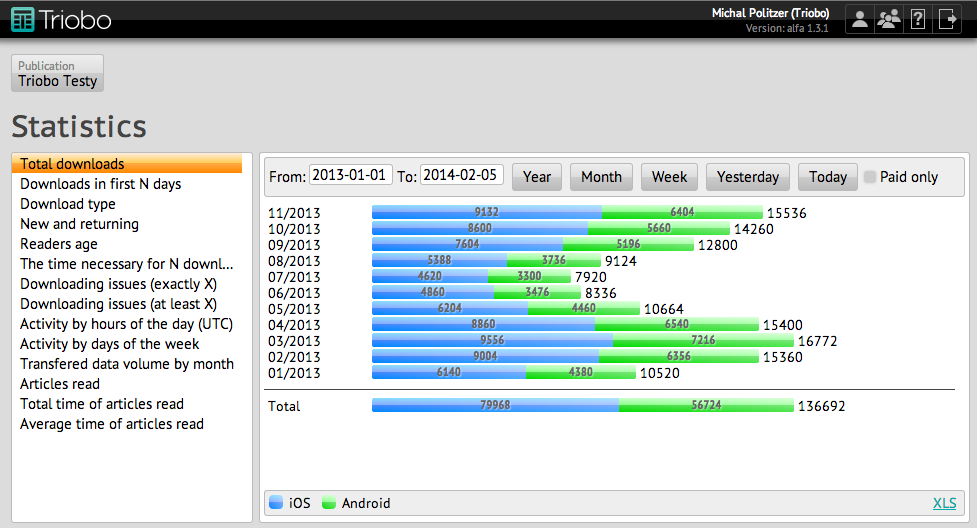
Each download or issue purchase is monitored so you can have an instant overview of how many readers have downloaded your publication. Detailed information can be found by clicking the icon Statistics in corresponding publication.

Statistics

Every view of data has different filtering options. In the upper part can be then entered:

  • Time period FromTo – the time period for which the data is collected. You can use shorcut buttons, which set the year, month, week, yesterday and today.
  • Only purchased – when you publish the charged issue, by this option you differentiate the display of all and only those issues that were purchased
  • Days from the publication date – use to view the data, when the number of days from publication are important
  • Number of downloads – use to view the data, when a given number of readers is important

Some views are concluded with a summary line Total. When you place your mouse cursor over each part of the chart, a supplementary information appears. The data can be stored in XLS format by clicking on the link at the bottom right.

Definition of terms:

  • downloads – this is the number of unique reading devices that have downloaded a certain issues within the specified period. Each device is counted only once, even in a situation where reader had deleted and re-downloaded such publication.
  • activity – this is the number of activities related to a given issue, and it also counts repetitions. Activities include downloading, buying or reading. If the reader reads or downloads the issue multiple times within a specified period, each of this activity will be counted.
  • reader and deading device – are equivalent terms from statistical point of view.

Issue statistics

Issue statistics are related to number of downloads, alternatively to other activities (purchasing, reading) and are available for all issue editions.

Total issue downloads

Displays the total number of downloads within the specified period. Data are sorted into individual channels (iOS, Android).

Issue downloads (first N days)

Displays the number of downloads within the first N days from publication. Downloads that have occurred after a specified number of days from each publication are ignored. This can instantly compare the efficiency of each issue, regardless of when they were issued (although all of them start at the same time).

Download type

Displays the number of downloads of each issue, depending on whether it was downloaded automatically, or manually, or whether it was a separate purchase.

New and returning
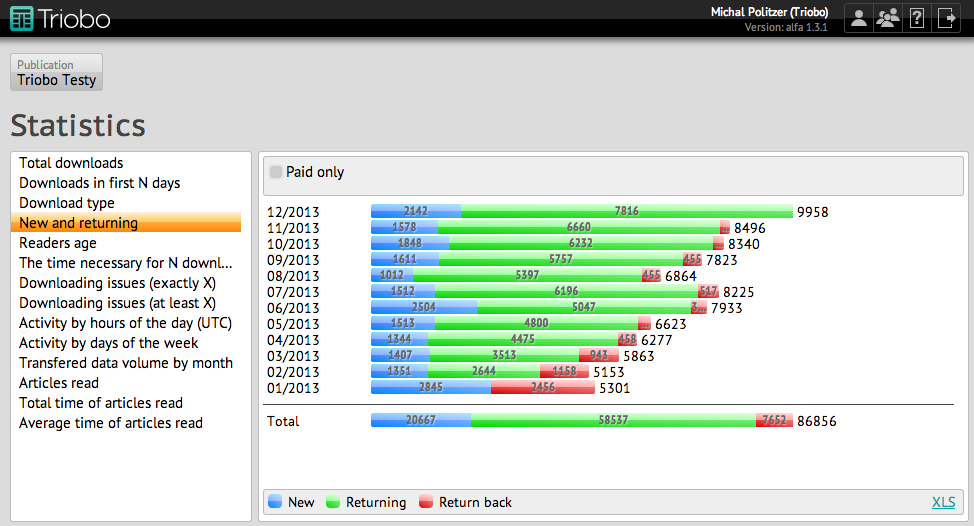
Statistics Individual downloads are divided according to whether it is newly downloaded issue (new reader) from given device, or whether older issue was previously downloaded from this device (returning reader), or whether newer issue was previously downloaded from this device (reader returning back to Old numbers).

Readers age
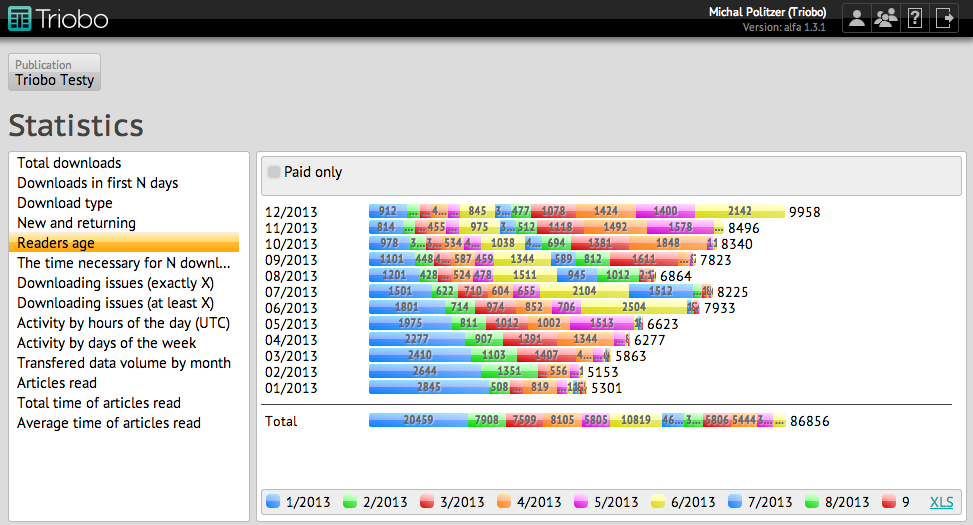
Statistics Each reading device is paired with a month when particular issue was uploaded to it for the first time. According to this classification number of downloads are essentially displayed for all issues. For example, if a user first downloaded an issue in July 2013, a blue color was assigned to it, so all issues that were downloaded will be displayed in blue.

The time necessary for N downloads
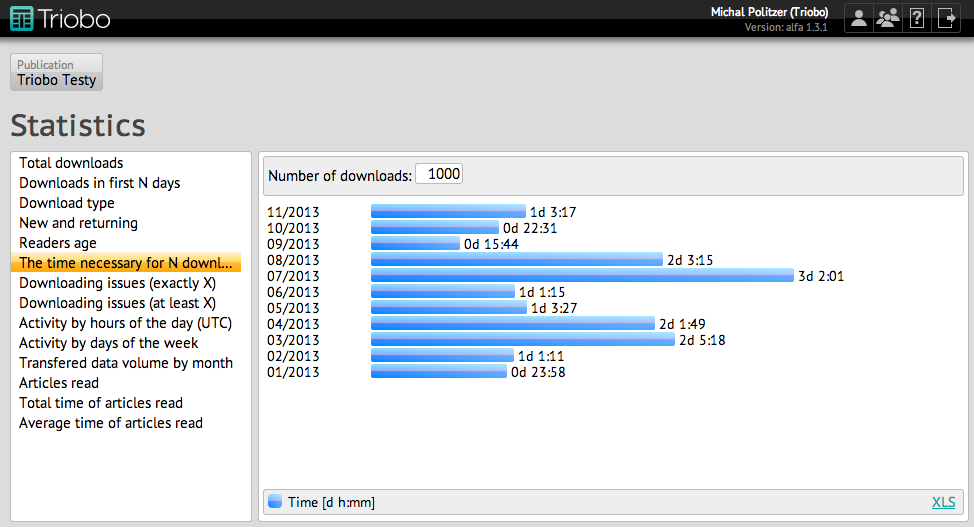
Statistics For each issue the time that had elapsed between the first and specified download is displayed. The smaller this value is, the more successful the issue is. Data is displayed in days, followed by hours and minutes.

Downloading issues (exactly X)
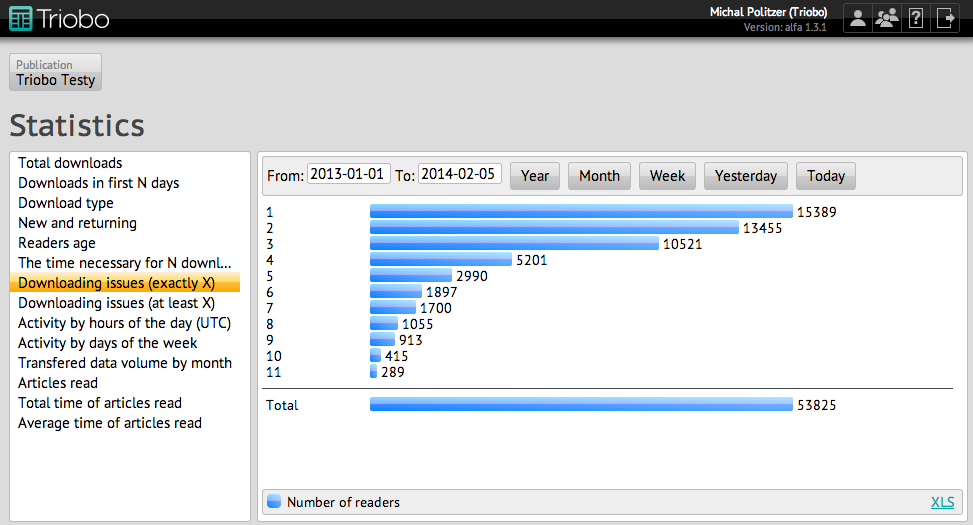
Statistics Sorts the devices from which just one, two or three issues, etc were downloaded within the specified period. For each issue the number shows the number of such devices. Each device may be found in one group. The total number shows the total number of devices that had downloaded some (or at least one) issue.

Downloading issues (at least X)
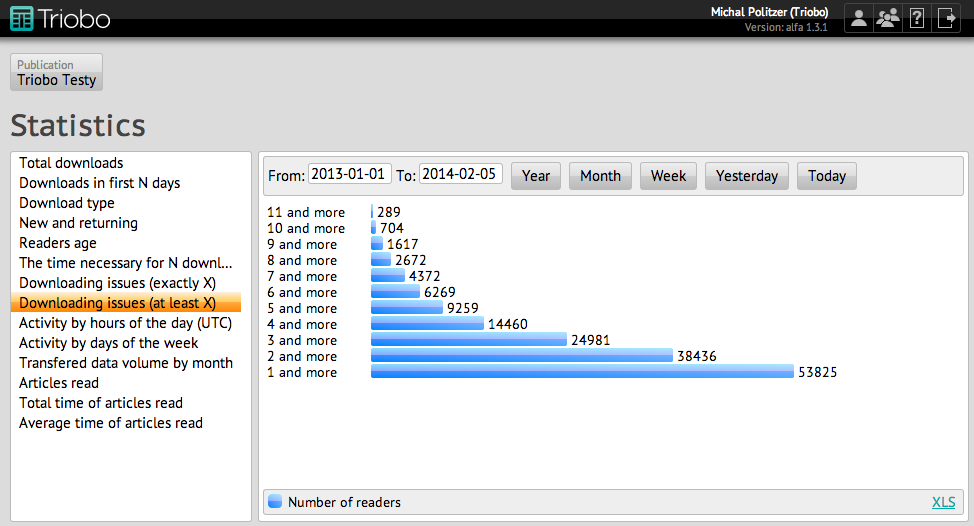
Statistics Same methods as in the previous graph, but the number of readers who have downloaded at least X (or more) issues are shown in each row. Last line thus contains the number of (different, unique) readers who have downloaded at least one (or any) issue within a specified period.

Activity by the hours of the day (UTC)

Shows for a specified period, when readers were reading or downloading, sorterd by hours. You will find out whether your readers are more active in the morning or evening.

Activity by days of the week

For a specified period it shows activity distributed by days of the week.

Transfered data volume by month

Quantity of downloads for each reporting month in GB. Accounting month is the calendar month shifted by as many days, as how much the beginning of the contract was shifted compared to calendar month. Example: if the customer has signed a contract on 20th May, the shift of the accounting month is 19 days, i.e. as his accounting month “September 2013” starts on the 20th September 2013 and ends on the 19th October 2013.

Article statistics

Customers with Professional tariff have available also article statistics. Statistics are generated and sent out during the reading of magazine by a reader. If the reader is without an internet connection (offline reading), statistics will be sent at the earliest possible opportunity.

Articles read
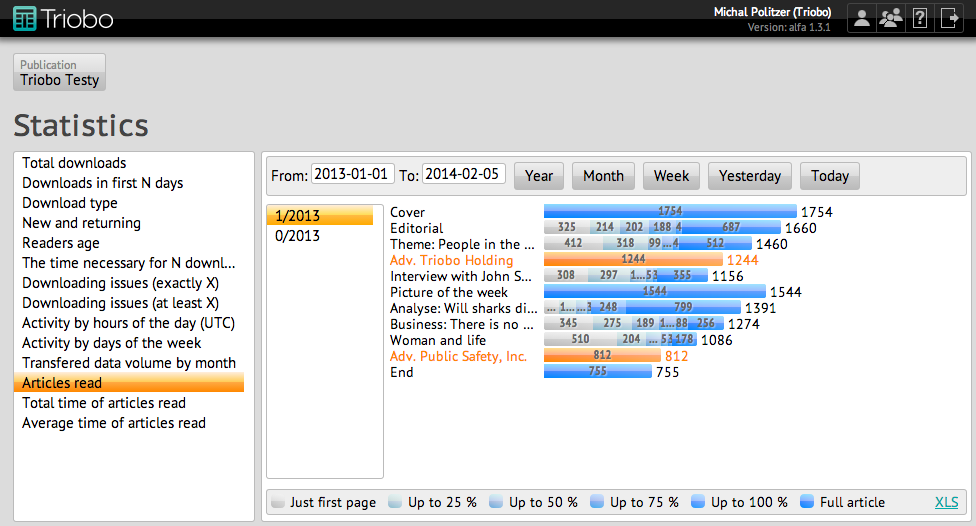
Statistics Number of readers who have viewed particular article. With rolling and multipage articles readers are divided into groups according to whether they had read only the first page, up to 25% article length, to 50% article length, to 75% article length, to 100% of the article length or entire article (i.e. rolled up to the end). Color-highlighted lines show articles marked as advertising.

Total time of articles read

The sum of time that readers had spend on each article. If the length exceeds 30 minutes it is always counted only as 30 minutes. The total time shows the total time that readers had spent on the entire issue. Time is given in hours: minutes: seconds.

Average time of articles read

The average time that readers had spent over individual articles. The total average time expresses how much time on average a reader had spent reading the issue. Time is given in hours: minutes: seconds.
Categories
3. Content publishing for tablets

Before sending your application to AppStore / Google Play / Windows Store

Should you decide to buy a price package Triobo Professional, we will do all substantial things for you. Nevertheless, we still need some information and graphic materials from you. Here is a list of some of them. In following examples we will assume that your publishing company is called OurCompany and operates in the Czech Republic, owns the domain ourcompany.cz and will publish a magazine called MyMagazine.

Internal setting of application

The following information is generally hidden to readers, but we still need to enter it and therefore it is good to think of them ahead of time because they cannot be changed afterwards:

  • App ID – internal name of application, only English characters, no spaces, typically “mymagazine”
  • Bundle ID – globally unique application identifier, Apple recommends reverse entry, as in the domain case, i.e. typically “cz.ourcompany.mymagazine”
  • Product ID – if you want to sell the magazine by individual issues, by subscription, or even by individual articles, each such product has to have its own ID. It must start similarly as Bundle ID. If in 2013 for example you will be issuing publications from 1 to 12, then we suggest to use the following product ID: “cz.ourcompany.mymagazine.1301”, “cz.ourcompany.mymagazine.1302”, “cz.ourcompany.mymagazine.1303” etc. to “cz.ourcompany.mymagazine.1312”. For subscriptions always (!) use “cz.ourcompany.mymagazine.subscr.length”, where the subscription length is the month, quarter, half, year
  • SKU – apparently the completely unnecessary item, that is mandatory, is at least two-character identifier. You can use it later if you want to pair something with your accounting, otherwise we recommend numbering the applications as 11, 12, 13, 14 …

Application settings

The following information will affect the behavior of this application:

  • applications for iPad or universal – let us know if you want your application for iPad only, or whether it is intended for iPhone as well. Do not forget to supply the appropriate graphics (see below)
  • rotation lock – we can ban the rotation on iPad or iPhone, independently from each other. Typical are the following options:
    • permitted rotation on iPad and iPhone – common setting if your application is “portrait oriented”, it will be possible to also read landscape text on iPad and iPhone, the content stretches to the entire width of the screen.
    • restricted rotation on iPad, but permitted on iPhone – you may, for example, force portrait reading on iPad, but on iPhone rotation is allowed. This is convenient on iPhone because at landscape rotation the text size that was originally intended for iPad stays sufficiently legible. By iPad locking you namely force the reader to read magazine as originally intended, however in automatic galleries it will not be possible to display rotated images in formats that fill display optimally.
    • restricted rotation both on iPad and iPhone – we do not recommend this, however it is possible. On iPhone it is possible to restrict only the portrait orientation (it is not possible to force the complete publication only to “Landscape” – we are preparing this feature in succeeding versions)
  • Newsstand placement (Newsstand) – Newsstand for iPad / iPhone is nothing more than a special folder for applications, however this information is necessary to know in advance when setting up the reader. Advantages and disadvantages:
    • placed within the Newsstand – magazine is not presented by an icon, but the actual envelope. The publication must be subscription based (if this is a free magazine, it can be a free subscription). The application name will not be displayed anywhere (see the next point). The Newsstand will contain only publications (= periodically issued publications).
    • placed outside of Newsstand – magazine will be presented by its icon, at first glance it looks like any other application. The advantage is that the reader can rearrange it wherever he needs. The purchases within the application are not limited in any way, they may or may not – be subscription based.
    • note.: separate publications Triobo Single cannot be added to the Newsstand
  • application name on display – how the application will be named on device display. Note that when the text is longer than about 12 characters, it may be inadvertently shortened. In our case, we recommend “My Journal”, but definitely do not recommended “My Exclusive Magazine”, which will be shortened to “My Exluz ine…”

Application settings in AppStore

AppStore currently does not support the Czech language. Therefore it is necessary to use English as the default language. You can write captions in Czech, however we recommend to use English texts when you first submit them to the AppStore, which will be followed by words “CZECH” and it will continue with Czech texts. The point is that the person in Apple has an idea of what it is. Most captions can be changed later and English be removed. Alternatively, you may swap the Czech and English text so that the Czech is more visible.

  • application name in AppStore – may be longer than the application name on display such as “My Magazine – tablet edition.” This information cannot be changed after the approval of application, but you may change it with the next version and sent to the AppStore (therefore it will always be subjected to Apple approval)

  • copyright – information that the application displays, such as “Our company, a.s.”

  • description – text that will be shown in the application. Firstly we recommend at least one sentence description in English, which may be followed by the Czech version. Description can be always changed later, so you can delete it after the approval of English version.

  • key words – words by which readers can easily find your application. This is limited to 150 characters, so we recommend that the magazine about tourism and trips to Europe, uses for example the description “magazine hiking tours Europe”

  • internet link, support – ideally to refer to magazine website, e.g. “http://mymagazine.ourcompany.cz”

  • privacy Policy document link – the item is mandatory if your magazine is present at the Newsstand. Somewhere on your website create a statement containing provision of personal data use in Czech and English (example here: http://www.epublishing.cz/zasady-ochrany-osobnich-udaju)

  • age restrictions – this is the information on whether the application contains information about violence, alcohol, drugs, light erotica, vulgarity, etc. – if your magazine may contain any such facts, we strongly recommend to disclose it before the approval and identify the application as a 17+

  • screens – we can prepare screens for you, just let us know which pages should we use, or send us your samples. For iPad they must be sized 768×1024 or 1024×768 for iPhone 640×960 or 960×640 for iPhone5 640×1136 or 1136×640. Screen samples in AppStore, can be changed only until the final application is approved by Apple, screen samples in Google Play can be changed any time.

Graphics

In the following list, we always state requested name and in brackets behind it the size in pixels. Do not think of data as dpi, we need you to have the real image dimensions in your graphic editor exactly as we state. Use exclusively the PNG format.

  • Main icon – has dimensions of 1024 x 1024 and we may derive all other required sizes from it. When designing make sure that the icon would be recognizable even at the resolution of 57 x 57 (iPhone). iPad readers will see the icon at the size of 72 x 72. Name the file as follows:
    • mymagazine-icon.png (1024 x 1024)
  • startup screen for iPad – is that what appears when the application starts. Regardless of the fact that the application has or has not locked its rotation, we need both formats. Pay attention to the correct size and use the following names:
    • mymagazine-landscape.png (2048 x 1536)
    • mymagazine-portrait.png (1536 x 2048)
  • startup screen for iPhone – we need this only if your application will be also used on iPhone. Urgently both formats (one for the older iPhone, the other for the iPhone5):
    • mymagazine-iphone.png (640 x 960)
    • mymagazine-iphone5.png (640 x 1136)
  • startup cover – is needed only if your magazine is to be present at the Newsstand. This must be a picture that evokes the appearance of magazine cover while this is not a real cover. The easiest way to do this is to take a real cover and delete all texts from it except the logo and replace the main motive with something else. Size may be either 1024 x 768 or 768 x 1024, according to the format size of your publication:
    • mymagazine-cover.png (1024 x 768 or 768 x 1024)
  • screenshot examples of your app – if you want to select which screenshots will appear in your application, send us either numbers of pages you want to use (and we will implement them to your reader), or PNG images of selected pages. You may use at most 5 screenshots so supply them in three following resolutions:
    • IPad and Android devices: 768 x 1024 or 1024 x 768 (depending on the orientation of your publication)
    • For iPhone4: 640 x 960 or 960 x 640
    • For iPhone5 and higher: 640 x 1136 or 1136 x 640 (if you do not provide us with application samples, we will choose 3 screens ourselves – you can easily change them later. In case of Apple it is necessary to do this before the application is approved)

Summary

So what to send then? In addition to the files listed in the previous section you may also fill in the following table and send it to us:

Item Value
App ID
Bundle ID
SKU
Applications for the iPhone Yes No
Lock rotation iPad No Portrait only Landscape only
Lock rotation iPhone No Portrait only
Newsstand placement Yes No
Application name on display (12 characters)
Application name in AppStore
Copyright
Description
Key words
URL support
URL privacy policy
age restrictions No Yes, what age:
Categories
1. Starting with digital publishing 3. Content publishing for tablets

Proof read before publication release

Before you publish your digital publication (for digital magazines) or send it to the approval process (for Triobo Single), do not forget to verify the correctness and performance of interactive elements on a real tablet. Publishing reader Triobo Reader serves this purpose and is available at both Apple iOS and Android. Instructions how to use Triobo Reader, are available here.

If you publish on Apple and Android, we strongly recommend to double check your work on both types of devices. Do not count on the fact that tablets with Android will always behave identically as Apple. Risky are tablets with Android version 4.0, whose operating system has unfortunately a number of imperfections. These errors have been fixed on newer versions of Android indeed (4.1 and above), nevertheless a number of tablet manufacturers still sell the old versions.

If you encounter setbacks with specific interactive element on Android 4.0, it is necessary to update the operating system – or design your interactive element in other way. The problem lies in tablet operating system and not in Triobo solution.

Encourage your readers to select only those tablets, for which the manufacturer guarantees Android updates and bug fixes, version 4.1 is already perfect for such use.

Categories
1. Starting with digital publishing 3. Content publishing for tablets

Digital publishing workflow

Triobo workflow

  • Registration is free with Triobo. Nothing has to be installed, Triobo is fully web-based application.
  • In a publishing editor you can design your interactive digital publication for free.
  • There is a preview mode (preview) available directly within the editor.
  • It is always possible to check a free publication without any charge on a real tablet or smart phone – thanks to the Triobo Reader application (instructions here).
  • Once you have your publication ready for distribution to readers, just at this moment a contractual relationship with Triobo comes to play and start of paid services may begin.
  • The result of digital publishing with Triobo is always a digital publication / application published in the AppStore / Google Play under your brand with your name and your icon.